 ✨ AI Generated
Sanjo Ohashi Bridge
Japanese: 三条大橋
Nakagyo Ward, Kyoto
This information was written by AI and may contain mistakes. Please check official sources for opening hours, fees, and other details before you go.
Found a mistake? Let us know with “✏️ Something's wrong” on this spot's screen in asobot →
🎧 Audio guide(1:04)
In short
Sanjo Ohashi Bridge spans the Kamo River and once served as a vital transportation hub as the western terminus of the Tokaido's 53 stations. It underwent a major renovation in 1590 (Tensho 18) by order of Toyotomi Hideyoshi, and its current form comes from a reconstruction in 1950 (Showa 25). In December 2023 (Reiwa 5), construction renewing the railings, pavement, lighting, and other elements was completed.
- Inscriptions on the Giboshi (Finials): The railings feature a mix of giboshi from the Tensho era and the Showa era, and their inscriptions convey the scale of the great construction work of Hideyoshi's era
- Tensho Stone Pillars: On the northern side of the bridge's western end, stone pillars used in the great Tensho renovation remain preserved
- Statue and Monument at the Eastern End: There is a bronze statue of Takayama Hikokuro and the "Ekiden Monument," which commemorates Japan's very first ekiden (relay road race)
History and Highlights
Sanjo Ohashi Bridge is a bridge spanning the Kamo River that once served as a vital transportation hub as the western terminus of the Tokaido's 53 stations. While the exact time of its original construction remains unclear, a simple bridge is believed to have already stood here in the early Muromachi period. It became a full-scale bridge in the 18th year of Tensho (1590), when magistrate Mashita Nagamori carried out a major renovation by order of Toyotomi Hideyoshi. Although it was subsequently washed away on multiple occasions, it was promptly repaired each time as a kogi-bashi (a bridge directly managed by the shogunate).
The bridge assumed its current form through a reconstruction in Showa 25 (1950), measuring 74 meters in length and 15.5 meters in width. In recent years, the City of Kyoto carried out the "Sanjo Ohashi Bridge Repair and Landscape Enhancement" project, renewing the wooden railings, pavement, lighting, and other elements, with construction completed in December of Reiwa 5 (2023).
Points for Viewing and Experiencing
- Inscriptions on the Giboshi (Finials): The giboshi (ornamental finials) lining the railings include a mix of those from the Tensho era and the Showa era. The inscription on the finials notes that "the bedrock foundations penetrate five fathoms into the ground, and there are sixty-three cut stone pillars," conveying the sheer scale of the renovation during Hideyoshi's era.
- Tensho Stone Pillars: The northern side of the bridge's western end was once the site of a kosatsuba (public notice board area), and stone pillars used in the great Tensho renovation remain preserved there today.
- Statue and Monument at the Eastern End: At the eastern end stands a bronze statue of Takayama Hikokuro, related to the anecdote of him bowing in deep reverence toward the distant Imperial Palace. The original statue was erected in Showa 3 and removed during wartime for metal donations, before being rebuilt in Showa 36. To the north of the eastern end stands the "Ekiden Monument," which commemorates Japan's very first ekiden (relay road race) held in Taisho 6 (1917), which ran from here to the Shinobazu Pond in Ueno, Tokyo.
Tips for Strolling
The nearest station is Sanjo Station on the Keihan Railway. From atop the bridge, you can view the surrounding mountains of Mt. Hiei, Kitayama, and Higashiyama. Pontocho, which lines the western bank, still retains the atmosphere of a traditional geisha district, and in winter, black-headed gulls take flight over the Kamo River. Pontocho-dori Street is about 350 meters to the south, and Honno-ji Temple is about 350 meters to the west.




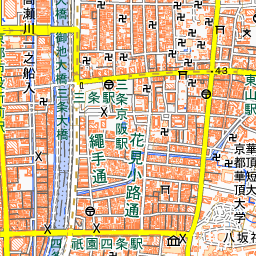


Spot location © OpenStreetMap contributors (ODbL)
Open in Google MapsGuides that include this spot (1)
Use asobot while you walk
- See where you are on the map and find spots nearby
- Listen to the guide's audio in course order, one after another (with subtitles)
- Walk to the next spot while following the map
Open on your phone
Scan to open this spot in asobot on your phone.