 ✨ AI Generated
Mihara Castle Ruins
Japanese: 三原城跡
Mihara, Hiroshima
This information was written by AI and may contain mistakes. Please check official sources for opening hours, fees, and other details before you go.
Found a mistake? Let us know with “✏️ Something's wrong” on this spot's screen in asobot →
🎧 Audio guide(1:06)
In short
The Mihara Castle Ruins are castle ruins integrated with JR Mihara Station. The castle was built by Kobayakawa Takakage, the third son of Mori Motonari, by connecting the islands of Oshima and Kojima facing the Seto Inland Sea, and it is said to have also been called "Ukishiro" (floating castle) because it looked as though it were floating on the sea at high tide. In 1957 (Showa 32), the castle ruins were designated as a National Historic Site as one of the Kobayakawa Clan Castle Sites.
- One of Japan's largest tenshudai: Spacious enough to fit six main keeps of Hiroshima Castle, it is constructed using a unique method known as "aburi-zumi"
- Corner from the era of Takakage: The southwest corner of the tenshudai is believed to remain from the time of Kobayakawa Takakage
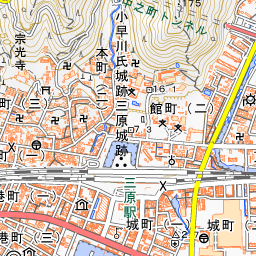
- Accessing the tenshudai from the station: JR Mihara Station is located on the site of the former honmaru, and a unique feature is that the tenshudai can be accessed from the station concourse
History and Highlights
The Mihara Castle Ruins are castle ruins integrated with JR Mihara Station. Mihara Castle was built by Kobayakawa Takakage, the third son of Mori Motonari and a renowned strategist of the Sengoku (Warring States) period. Built by connecting the islands of Oshima and Kojima facing the Seto Inland Sea, it featured boat inlets opening out to the sea that served as a naval port, making it a castle unique to the Kobayakawa clan, who commanded naval forces. It is said to have also been called "Ukishiro" (floating castle) because it looked as though it were floating on the sea at high tide.
According to documents of the Kobayakawa family, the castle is said to have been built in 1567 (Eiroku 10), but it is believed that it was developed into its current castle form mainly from the Keicho era to the beginning of the Edo period, when Fukushima Masanori ruled. Takakage passed away inside this castle in the second year of Keicho. Mihara Castle later became a branch castle of Hiroshima Castle, and when Asano Nagaakira replaced the Fukushima clan in Genna 5 (1619), Asano Tadayoshi became the castle lord, after which it was inherited through generations until the Meiji Restoration.
The former castle is said to have been a large fortress extending about 900 meters east to west and about 700 meters north to south, featuring the honmaru (main bailey), ninomaru (second bailey), and sannomaru (third bailey), as well as 32 turrets and 14 castle gates. When the Sanyo Railway was laid, part of the honmaru was demolished, and due to coastal reclamation and the expansion of the urban area, its complete original form can no longer be seen on the ground today. In 1957 (Showa 32), the castle ruins were designated as a National Historic Site as one of the Kobayakawa Clan Castle Sites.
Highlights for Viewing and Experiencing
- Stone Walls of the Tenshudai: Today, the stone walls of the tenshudai (keep foundation), Funairi-yagura turret, and Chumon gate remain. The tenshudai is one of the largest in Japan, spacious enough to fit six main keeps of Hiroshima Castle. Its beautiful, sweeping fan-like slope is exceptional, constructed using a unique method known as "aburi-zumi."
- Corner from the Era of Takakage: The southwest corner of the tenshudai is stacked using natural stones with minimal shaping. Based on the presence or absence of the sangi-zumi corner-stacking technique, it is believed that the southwest corner remains from the time of Kobayakawa Takakage, while the other sections were renovated during the time of Fukushima Masanori.
- Accessing the Tenshudai from the Station: JR Mihara Station is located on the site of the former honmaru, and a unique feature is that the tenshudai can be accessed directly from the station concourse. Redevelopment of the castle ruins was completed in 2017, and it is now enjoyed by visitors as a relaxing park.
Walking Tips
The tenshudai is just a short walk from inside Mihara Station. By car, it takes about 15 minutes from the Mihara-Kui Interchange on the Sanyo Expressway. Castle stamps (gojoin) of Mihara Castle are sold at the Ukishiro Lobby Tourist Information Center inside JR Mihara Station. From the Mihara Castle Ruins, you can also take a drive to Buttsu-ji Temple, famous for autumn leaves, or Sankeien Garden near Hiroshima Airport.

Spot location © OpenStreetMap contributors (ODbL)
Open in Google MapsGuides that include this spot (1)
Use asobot while you walk
- See where you are on the map and find spots nearby
- Listen to the guide's audio in course order, one after another (with subtitles)
- Walk to the next spot while following the map
Open on your phone
Scan to open this spot in asobot on your phone.