 ✨ AI Generated
Kennin-ji Temple
Japanese: 建仁寺
Higashiyama Ward, Kyoto
This information was written by AI and may contain mistakes. Please check official sources for opening hours, fees, and other details before you go.
Found a mistake? Let us know with “✏️ Something's wrong” on this spot's screen in asobot →
🎧 Audio guide(0:59)
In short
Kennin-ji Temple is the head temple of the Kennin-ji branch of the Rinzai sect and the first Zen temple in Kyoto. In 1202 (Kennin 2), Shogun Minamoto no Yoriie donated the land, and the temple was founded with Zen Master Yosai as its founding abbot. Zen Master Yosai spread the custom of tea drinking and is revered as the father of tea in Japan.
- Folding Screen of Wind God and Thunder God: A National Treasure folding screen by Tawaraya Sotatsu. The original is deposited at the Kyoto National Museum, and a high-definition reproduction is on display at Kennin-ji Temple
- Twin Dragons in the Dharma Hall: Two dragons painted by Koizumi Junsaku to commemorate the 800th anniversary of the temple's founding, completed in 2002 (Heisei 14). The painting spans the size of 108 tatami mats
- The Three Gardens: There are the Daiyuen, a dry landscape garden in front of the Hojo; the Cho-on-tei, which looks like the front from any of its four sides; and the Circle-Triangle-Square Garden
History and Highlights
Kennin-ji Temple is the head temple of the Kennin-ji branch of the Rinzai sect and the oldest Zen temple in Kyoto. In the second year of the Kennin era (1202) during the Kamakura period, Shogun Minamoto no Yoriie donated the land, and the temple was founded with Zen Master Yosai as its founding abbot. The temple took its name from the era name at the time, and its mountain name (sangō) is Tozan. Initially, it was a training hall combining the study of Tendai, Esoteric Buddhism, and Zen, but under the 11th abbot, Rankei Doryu, it became a purely Zen practice hall. Later, it was ranked third among the Kyoto Gozan (Kyoto's Five Great Zen Temples) established by the Muromachi Shogunate and flourished under generous patronage. The current Hojo (abbot's hall) was relocated from Ankokuji Temple in Aki Province by Ankokuji Ekei in the 4th year of Keicho (1599), and together with the Chokushimon Gate (Imperial Messenger Gate), it is designated as a National Important Cultural Property.
Zen Master Yosai traveled to Song dynasty China twice, encouraged the cultivation of tea seeds he brought back, and authored the "Kissa Yojoki" (Drinking Tea for Nourishment of Life), spreading the custom of tea drinking. For this reason, he is revered as the father of tea in Japan, and every year on April 20, his birthday, the Yotsugashira Tea Ceremony is held following traditional etiquette.
Viewing and Experience Highlights
- Folding Screen of Wind God and Thunder God: A National Treasure folding screen regarded as the masterwork of Tawaraya Sotatsu's later years. On the pair of two-panel gold-leaf screens, the Wind God is depicted on the right and the Thunder God on the left. The original is deposited at the Kyoto National Museum, and a high-definition reproduction is on display at Kennin-ji Temple.
- Twin Dragons on the Ceiling of the Dharma Hall (Hatto): Covering the entire ceiling of the Dharma Hall, which also serves as the Buddha hall, are two dragons painted with mouths depicting "A-un" (open and closed). Painted by the artist Koizumi Junsaku to commemorate the 800th anniversary of the temple's founding, it was completed in the 14th year of Heisei (2002). Its area spans the size of 108 tatami mats.
- The Three Gardens: The Daiyuen garden in front of the Hojo is a dry landscape garden created in the early Showa period, modeling the scenery of Mount Baizhang in China. The Cho-on-tei garden in the inner courtyard of the main quarters features three standing stones (Sanzonseki) in the center, a meditation stone (Zazenseki) to the east, and maple trees around them; it is a Zen garden designed to be viewed from the front from any of the four sides. The Circle-Triangle-Square Garden (Maru-Sankaku-Shikaku Garden) represents the fundamental shapes of the universe through three simple forms, and it is also said to represent earth, water, and fire through a square, circle, and triangle.
Walking Tips
It is about a 7-minute walk from Gion-Shijo Station on the Keihan Railway. The Chokushimon Gate facing Yasaka-dori preserves the appearance of the late Kamakura period to this day, and because arrow marks from wartime conflicts remain on its pillars and doors, it is also called the "Yanone-mon" (Arrowhead Gate). From this gate, the Sanmon Gate, Dharma Hall, and Hojo are aligned in a straight line from south to north. To the north extends Hanamikoji-dori Street, which was opened as far as Kennin-ji Temple in the early Meiji period. Yasui Konpiragu Shrine is about 200 meters to the east, and Hokan-ji Temple (Yasaka Pagoda) is about 550 meters to the southeast.
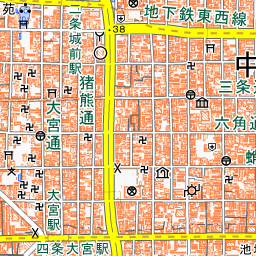

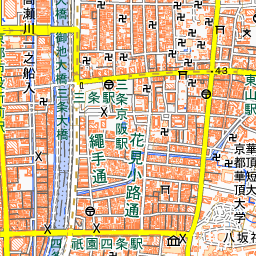


Spot location © OpenStreetMap contributors (ODbL)
Open in Google MapsGuides that include this spot (2)
Use asobot while you walk
- See where you are on the map and find spots nearby
- Listen to the guide's audio in course order, one after another (with subtitles)
- Walk to the next spot while following the map
Open on your phone
Scan to open this spot in asobot on your phone.