 ✨ AI Generated
Honpo-ji Temple
Japanese: 本法寺
Kamigyo Ward, Kyoto
This information was written by AI and may contain mistakes. Please check official sources for opening hours, fees, and other details before you go.
Found a mistake? Let us know with “✏️ Something's wrong” on this spot's screen in asobot →
🎧 Audio guide(1:11)
In short
A head temple of the Nichiren sect founded by Priest Nisshin, a Nichiren monk active during the Muromachi period. Its origins are said to trace back to a "Guzusho" (a propagation hall) built in 1436 (Eikyo 8), and it moved to its current location in Horikawa Teranouchi in 1587 (Tensho 15). It is the family temple of the Hon'ami family, which produced Hon'ami Koetsu, and when the temple was relocated, Koetsu, together with his father Koji, invested private funds to develop the temple complex.
- "Tomoe-no-niwa" (Nationally Designated Place of Scenic Beauty): Said to have been designed by Koetsu, this garden is also called "Mitsu-tomoe-no-niwa" because its three artificial hillocks represent the comma-shaped "tomoe" crest. In front of the Shoin's veranda, a circular stone and a decagonal lotus pond are laid out, symbolizing "nichi" (日) and "ren" (蓮)
- Hasegawa Tohaku's "Butsu Nehan-zu" (Nirvana Painting): Painted in his 60s by Tohaku, who resided in a sub-temple of Honpo-ji Temple, this Important Cultural Property is a monumental work measuring as much as 10 meters high and 6 meters wide, including the painted mounting. A full-scale replica is usually on display, and the original work can be viewed every year between March 14 and April 15
- Temple Treasures Related to Koetsu: Handed down here are items such as the Important Cultural Property Hana Karakusamon Raden Kyobako (Sutra Box with Floral Arabesque Design in Raden Inlay), in whose production Koetsu was involved, and the Nyosetsu Shugyo Sho, transcribed by Koetsu from the writings left by Nichiren Shonin
History and Highlights
Honpo-ji Temple is a head temple of the Nichiren sect founded by Priest Nisshin, a Nichiren monk active during the Muromachi period. Its origins are said to trace back to a "Guzusho" (a propagation hall) built at Higashinotoin Ayanokoji in 1436. After undergoing relocations due to two destructions and religious persecution, the temple moved to its current location in Horikawa Teranouchi in 1587 as part of the urban redevelopment accompanying Toyotomi Hideyoshi's construction of Jurakudai.
It is the family temple of the Hon'ami family, which produced the artist Hon'ami Koetsu. When the temple was relocated to its present site, Koetsu, together with his father Koji, invested their private funds to develop the temple complex. Although the temple was destroyed in the Great Fire of 1788—leaving only the scripture storehouse (Kyozo) and the treasure storehouse (Hozo) intact—the main hall (Hondo), Kaisando hall, Tahoto pagoda, Shoin study, and Niomon gate were subsequently rebuilt. These buildings are designated Tangible Cultural Properties of Kyoto Prefecture.
Viewing and Experience Points
- "Tomoe-no-niwa" (Nationally Designated Place of Scenic Beauty): Said to have been designed by Koetsu, this garden was designated a Place of Scenic Beauty by the national government in 1986. It is also called "Mitsu-tomoe-no-niwa" because its three artificial hillocks represent the comma-shaped "tomoe" crest. In front of the Shoin's veranda, a circular stone arrangement made of two semicircles and a decagonal lotus pond constructed of cut stones are laid out, symbolizing the sun ("nichi") and the lotus ("ren").
- Hasegawa Tohaku's "Butsu Nehan-zu" (Nirvana Painting): Hasegawa Tohaku resided in a sub-temple of Honpo-ji Temple and engaged in his artistic creations. Painted when he was in his 60s, the Butsu Nehan-zu is an Important Cultural Property, a monumental work measuring approximately 10 meters high and 6 meters wide, including the mounting. On the back of the mounting, memorial inscriptions are written for his son Kyuzo, who died young, among others. A full-scale replica is usually on display, and the original work can be viewed every year between March 14 and April 15.
- Temple Treasures Related to Koetsu: The Hana Karakusamon Raden Kyobako (Sutra Box with Floral Arabesque Design in Raden Inlay), in whose production Koetsu was involved, is an Important Cultural Property; it was crafted to house the Shishi Kinji Hokkekyo (Lotus Sutra written in gold on purple paper) penned by Ono no Michikaze. Other preserved items include the Nyosetsu Shugyo Sho, an essay of teachings transcribed by Koetsu from the writings left by Nichiren Shonin.
Tips for Exploring
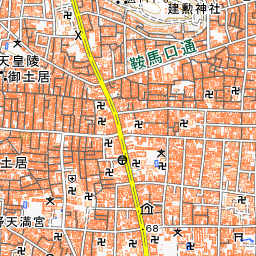
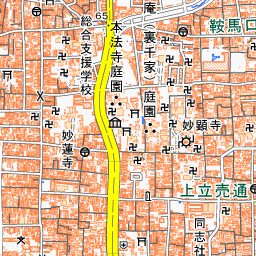
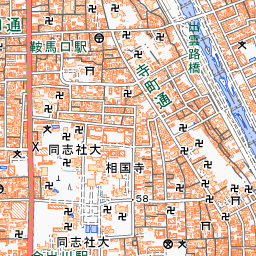
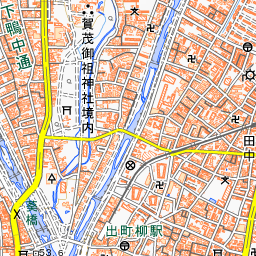
The temple is about a 3-minute walk from the "Horikawa Teranouchi" city bus stop, and about a 15-minute walk from Kuramaguchi Station on the Karasuma Subway Line. Just to the southwest is the Chado Research Center, a museum dedicated to the way of tea, and Myoken-ji Temple is situated a little over 200 meters to the east. It is a spot where visitors can explore both the temples of Teranouchi and tea ceremony culture together.




Spot location © OpenStreetMap contributors (ODbL)
Open in Google MapsUse asobot while you walk
- See where you are on the map and find spots nearby
- Listen to the guide's audio in course order, one after another (with subtitles)
- Walk to the next spot while following the map
Open on your phone
Scan to open this spot in asobot on your phone.