 ✨ AI Generated
Meiji Jingu Seitoku Memorial Picture Gallery
Japanese: 明治神宮聖徳記念絵画館
Shinjuku City, Tokyo
This information was written by AI and may contain mistakes. Please check official sources for opening hours, fees, and other details before you go.
Found a mistake? Let us know with “✏️ Something's wrong” on this spot's screen in asobot →
🎧 Audio guide(1:02)
In short
The Meiji Jingu Seitoku Memorial Picture Gallery is the central facility of the Meiji-jingu Shrine Gaien (Outer Garden). It exhibits 80 giant murals depicting the achievements of Emperor Meiji and Empress Shoken in chronological order of events. Completed in 1926, the white-domed building is designated as an Important Cultural Property of Japan.
- 80 Murals: The first 40 are Japanese-style paintings (Nihonga), and the latter 40 are Western-style paintings (Yoga), each measuring approximately 3 meters high by 2.7 meters wide.
- Early Museum Architecture: A reinforced concrete building with outer walls covered in Mannari stone from Okayama Prefecture.
- Front of the Ginkgo Avenue: The view of the building seen beyond the avenue of ginkgo trees is beloved as one of Tokyo's representative landscapes.
History and Highlights
The Meiji Jingu Seitoku Memorial Picture Gallery is the central facility of the Meiji-jingu Shrine Outer Garden. While the Inner Garden of Meiji-jingu Shrine was built with national funds, the Outer Garden was built as a memorial facility for Emperor Meiji by the Meiji Jingu Hosankai (support association), which was established by private volunteers including the industrialist Shibusawa Eiichi.
The building's design is based on the original draft by Kobayashi Masatsugu, which was selected as the first prize winner among 156 entries submitted in a public design competition. Construction began in 1919; although it encountered the Great Kanto Earthquake during construction, it did not collapse due to its earthquake- and fire-resistant design. It was completed on October 22, 1926. Constructed of reinforced concrete, its exterior walls are covered with Mannari granite from Okayama Prefecture. The top of the central dome stands at a height of 32.1 meters above the ground. Praised as an "early museum architecture in Japan incorporating linear design and pioneering techniques," it was designated as an Important Cultural Property of Japan in 2011 alongside the Meiji Jingu Treasure Museum.
The murals inside depict events from the birth of Emperor Meiji in 1852 to his passing in 1912. Western-style painter Goseda Horyu II conducted historical research for each motif to create historical reference sketches ("Gadai Koshozu"), which were distributed to the 76 artists who worked on the murals. Based on these sketches, the artists conducted their own extensive research as well.
Viewing and Experience Points
- 80 Works of Japanese and Western Painting: The murals are arranged in chronological order of their themes, with the first 40 being Japanese paintings and the latter 40 being Western paintings. The Japanese paintings are displayed in the east exhibition room, while the Western paintings are in the west. Because each piece is set flush into the wall surface, they are called "murals."
- Scenes Seen in Textbooks: The collection includes "Return of Political Power to the Emperor (Taiseihokan)" by Murata Tanryo, "Restoration of the Monarchy (Oseifukko)" by Shimada Bokusen, "The Charter Oath (Gokajo no Goseimon)" by Inui Nanyo, "Negotiation on the Surrender of Edo Castle" by Yuki Somei, and "Dispatch of the Iwakura Mission to the West" by Yamaguchi Hoshun. There are also works such as "Promulgation of the Constitution" by Wada Eisaku and "The Battle of Mukden in the Russo-Japanese War" by Kanokogi Takeshiro.
- Marble Interior: About 13 varieties of domestic Japanese marble are used throughout the building. As fossils can be found within some of these stones, take a moment to look closely at the walls and floors.
Walking Tips
It is about a 5-minute walk from JR Shinanomachi Station and about a 5-minute walk from Kokuritsu-Kyogijo Station on the Toei Oedo Line. The gallery is currently closed for building renovation work, which is scheduled to continue until 2027. The gallery stands directly in front of the ginkgo avenue, and the view of the building seen beyond the ginkgo avenue of the Meiji-jingu Shrine Outer Garden from the garden entrance on Aoyama-dori Avenue is one of Tokyo's iconic landscapes. For a stroll along the ginkgo avenue and the outer garden, please refer to the description of the Meiji-jingu Shrine Outer Garden. Suga-jinja Shrine is approximately 850 meters to the northeast.
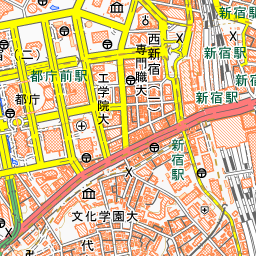


Spot location © OpenStreetMap contributors (ODbL)
Open in Google MapsGuides that include this spot (1)
Use asobot while you walk
- See where you are on the map and find spots nearby
- Listen to the guide's audio in course order, one after another (with subtitles)
- Walk to the next spot while following the map
Open on your phone
Scan to open this spot in asobot on your phone.