 ✨ AI Generated
Fukuyama Castle Museum
Japanese: 福山城博物館
Fukuyama, Hiroshima
This information was written by AI and may contain mistakes. Please check official sources for opening hours, fees, and other details before you go.
Found a mistake? Let us know with “✏️ Something's wrong” on this spot's screen in asobot →
🎧 Audio guide(1:03)
In short
Fukuyama Castle Museum is a museum inside the main keep of Fukuyama Castle. Fukuyama Castle was completed in 1622 by Mizuno Katsunari, the first lord of the Fukuyama Domain and a cousin of Tokugawa Ieyasu. The main keep, destroyed by fire in the air raid on Fukuyama in 1945, was rebuilt in 1966 and underwent major restorations during the "Reiwa no Ohbushin" (Great Renovation of the Reiwa Era) leading up to 2022, the 400th anniversary of the castle's construction.
- Iron Plating on the North Side of the Main Keep: The keep's appearance with black iron plates covering its north wall has been restored, and a structure with iron plating on the north side only is said to be unique in all of Japan
- Tracing Fukuyama's History Floor by Floor: The second floor introduces the first lord Mizuno Katsunari and the Mizuno family, and the third floor introduces Abe Masahiro, who brought about the opening of Japan, and the Abe family
- View from the Top Floor: From the top floor of the main keep, you can enjoy a 360-degree view of the Fukuyama city center
History and Highlights
Fukuyama Castle Museum is a museum located inside the main keep of Fukuyama Castle. Fukuyama Castle was built by Mizuno Katsunari, the first lord of the Fukuyama Domain and a cousin of Tokugawa Ieyasu. Construction began in 1620 and was completed in 1622. As a strategic stronghold to guard the western provinces, it is said that an exceptionally large castle was built, far exceeding what would typically be expected for a feudal lord of 100,000 koku. The five-tier, six-story main keep was destroyed by fire during the air raid on Fukuyama on August 8, 1945, but was rebuilt in 1966 through donations from local businesses and citizens.
During the "Reiwa no Ohbushin" (Great Renovation of the Reiwa Era) leading up to 2022, the 400th anniversary of the castle's construction, the main keep underwent major restorations. Based on research of old photographs and iron plates found on other castles, its appearance featuring black iron plating covering the north wall of the keep was restored. A structure with iron plating applied only to the north side of the main keep is said to be unique in all of Japan.
Viewing and Experience Points
- Iron Plating on the North Side of the Main Keep: Looking up at the main keep from the north, you will see a wall covered in black iron plates that differs from the other sides. Comparing it with the view from the south makes the difference clearly apparent.
- Tracing Fukuyama's History Floor by Floor: The basement floor introduces the historical background of the era when Fukuyama Castle was built and the castle's features, the second floor covers the first lord Mizuno Katsunari and the Mizuno family, and the third floor highlights Abe Masahiro and the Abe family, who helped realize the opening of Japan. On the fourth floor, there is a theater that projects video onto three large walls.
- View from the Top Floor: From the top floor of the main keep, you can enjoy a 360-degree panoramic view of the Fukuyama city center. Take a look and confirm for yourself how the castle sits right in the middle of the city.
Walking Tips
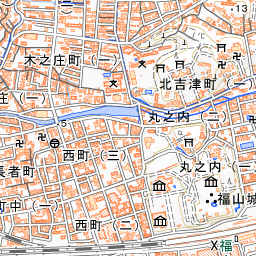
Fukuyama Castle is located in Fukuyama Castle Park, about a five-minute walk from the north exit of JR Fukuyama Station. In the park, the Fushimi Yagura (turret) and the Sujigane-gomon Gate remain, having survived the air raid on Fukuyama; both are designated as National Important Cultural Properties. The Fushimi Yagura was relocated from Fushimi Castle in Kyoto by order of the second shogun, Tokugawa Hidetada, and an inscription reading "Matsunomaru no Higashi Yagura" preserved on a beam substantiates its history. The name of the Sujigane-gomon Gate, which served as the main gate of the honmaru (main bailey), originates from the iron reinforcement strips affixed to the corners of its pillars and doors. At night, the main keep is illuminated. Within the park, you will also find the Fukuyama Museum of Art and the Hiroshima Prefectural Museum of History, making it recommended to visit them together.

Guides that include this spot (1)
Use asobot while you walk
- See where you are on the map and find spots nearby
- Listen to the guide's audio in course order, one after another (with subtitles)
- Walk to the next spot while following the map
Open on your phone
Scan to open this spot in asobot on your phone.