
Akutagawayama Castle Ruins
Japanese: 芥川山城跡
Takatsuki, Osaka
This information was written by AI and may contain mistakes. Please check official sources for opening hours, fees, and other details before you go.
Found a mistake? Let us know with “✏️ Something's wrong” on this spot's screen in asobot →
🎧 Audio guide(1:08)
In short
The remains of a Sengoku-period mountain castle built on Mount Miyoshi (commonly known as "Shiroyama") at an elevation of 182.69 meters, designated as a National Historic Site in 2022 (Reiwa 4) under the name "Akutagawa Castle Ruins." The castle was built by Hosokawa Takakuni from 1515 (Eisho 12), and from 1553 (Tenbun 22), Miyoshi Nagayoshi established his residence here and commanded the entire Kinai region in his own name. This is why Nagayoshi is regarded as a ruler of Japan who preceded Oda Nobunaga.
- One of the largest mountain castles in Osaka Prefecture: The castle's extent spans approximately 500 meters east-to-west and 400 meters north-to-south, with remains such as flattened enclosures (kuruwa), earthen ramparts (dorui), dry moats (horikiri), and "tate-dorui," earthen ramparts that descend straight down the slope
- Stone walls of the main entrance (Ote): In the valley along the southern main approach (ote), stone walls over 2 meters high are stacked. It is thought that these walls were meant to be "shown off" to visitors arriving at the castle
- Full-scale buildings atop the mountain: In an excavation of the main bailey, the remains of full-scale buildings were uncovered, featuring foundation stones, floored rooms, and surrounding verandas
History and Highlights
Akutagawayama Castle Ruins are the remains of a Sengoku-period mountain castle built on Mount Miyoshi (commonly known as "Shiroyama") at an elevation of 182.69 meters. It was a natural stronghold, its foot bounded on the north, west, and south by the gorge of the Akutagawa River, and in 2022 (Reiwa 4), it was designated as a National Historic Site under the name "Akutagawa Castle Ruins."
The castle was built between 1515 and the following year by Hosokawa Takakuni, who served as the kanrei (deputy shogun) of the Muromachi shogunate. It is said to have been a massive construction project with 300 to 500 people working day and night. In 1553, Miyoshi Nagayoshi captured the castle and established his residence here. For about seven years until he relocated to Iimori Castle in 1560, he commanded the entire Kinai region in his own name while employing figures such as Matsunaga Hisahide in important roles. This is why Nagayoshi is regarded as a ruler of Japan who preceded Oda Nobunaga.
In 1568, Oda Nobunaga, aiming for Kyoto, took possession of Akutagawayama Castle; from here, after assessing the situation together with the new shogun Ashikaga Yoshiaki, he made his entry into the capital. Wada Koremasa subsequently became the castle lord, but after Koremasa moved to Takatsuki Castle on the plain the following year, Akutagawayama Castle gradually ceased its role.
Viewing and Experience Highlights
- One of the largest mountain castles in Osaka Prefecture: The castle's extent spans approximately 500 meters east-to-west and 400 meters north-to-south. With the highest point of the mountain serving as the main bailey (shukaku), numerous flattened enclosures (kuruwa) were built along ridges and valleys, and earthen ramparts (dorui) and dry moats (horikiri) were placed at key positions. There are also rare remains called "tate-dorui," which are earthen ramparts that descend straight down the slope.
- Stone walls of the main entrance (Ote): In the valley along the southern main approach (ote), stone walls over 2 meters high are stacked. Stone walls were rarely used in castles of the Sengoku period, and it is thought that these walls were meant to be "shown off" to visitors arriving at the castle.
- Full-scale buildings atop the mountain: In an excavation of the main bailey conducted in fiscal year 1993, the remains of full-scale buildings were uncovered, featuring foundation stones, floored rooms numbering four or more, and surrounding verandas. This discovery revolutionized the previous view that mountain castles of the Sengoku period contained only simple structures.
Tips for Exploring
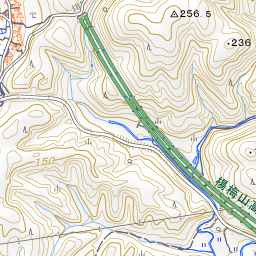
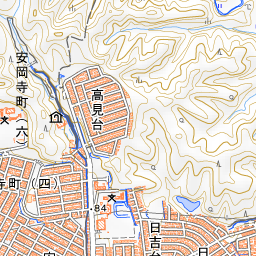
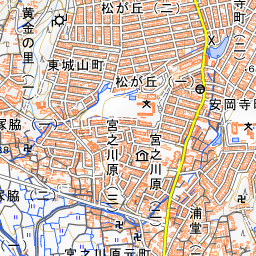
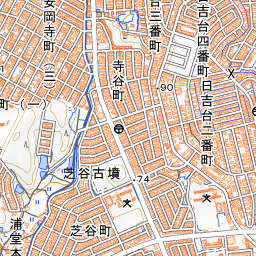
Take a municipal bus from the north bus stop at JR Takatsuki Station to "Tsukawaki," and from there walk up the hill for about 30 minutes. The path becomes unpaved along the way. The castle ruins are not a fully developed historic site; trees grow thick, and there are insects and snakes. As it is private property, please take care not to cause inconvenience to local residents. There is no parking lot, nor are there restrooms nearby. From the summit, you can enjoy a panoramic view of the Osaka Plain, stretching from the Ikoma Mountains to Osaka City. It is also good to combine your visit with a walk through the neighboring Settsukyo Park to the west. Materials concerning Miyoshi Nagayoshi and the castle can be viewed at the Takatsuki City Shiroato History Museum.






Use asobot while you walk
- See where you are on the map and find spots nearby
- Listen to the guide's audio in course order, one after another (with subtitles)
- Walk to the next spot while following the map
Open on your phone
Scan to open this spot in asobot on your phone.